

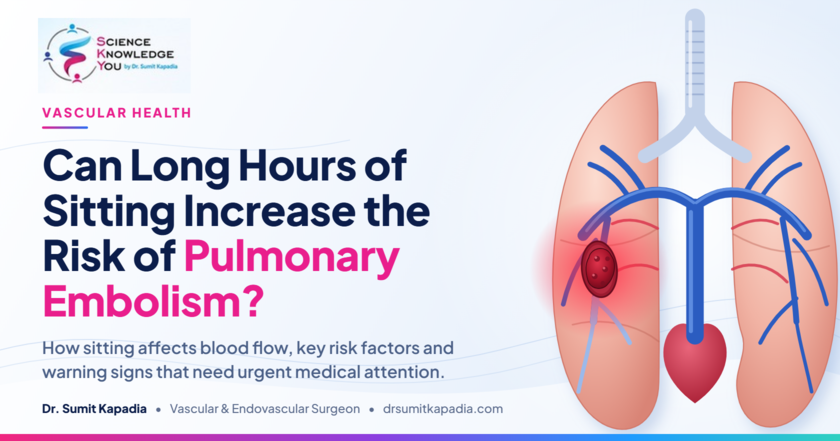
Prolonged sitting can slow blood flow in the leg veins, increasing the risk of blood clots. This is particularly relevant during long flights, car journeys or extended hours at a desk without any movement.
If a clot breaks loose and travels to the lungs, it can cause a potentially life-threatening condition called pulmonary embolism (PE). Today we will understand the meaning of a pulmonary embolism, how sitting impacts your circulation, and practical steps you can take to stay safe.
Key Takeaways
- Prolonged sitting can raise the risk of leg clots.
- A clot that travels to the lungs causes pulmonary embolism.
- Sudden breathlessness or chest pain needs emergency care.
- Short walks and leg exercises lower this risk.
What Is a Pulmonary Embolism?
A pulmonary embolism (PE) happens when a blood clot blocks an artery in the lungs. Most of these clots begin in the deep veins of the legs, break away, travel through the heart and lodge in a lung vessel.
The blockage limits blood flow to part of the lung and strains the heart. Prompt diagnosis and treatment are essential, as the condition can become life-threatening quickly. Early treatment lowers the chance of lasting lung damage and even death.
Can Long Hours of Sitting Increase the Risk of Pulmonary Embolism?
Spending too many hours in a seated position increases the risk of developing blood clots in the lower limbs that can eventually lodge in the lungs, resulting in a pulmonary embolism (PE). While walking helps the calf muscles pump blood back up the body, sitting for long periods leaves these muscles inactive.
Research has linked prolonged sitting to a higher risk of venous thromboembolism (VTE), which includes deep vein thrombosis (DVT) and pulmonary embolism (PE). A study of nearly 70,000 women followed over 18 years found that those who spent the most time sitting had more than twice the risk of an unexplained pulmonary embolism compared with those who sat the least.
However, prolonged sitting is not the only possible risk factor. There are other risk factors that include advanced age, obesity, prior surgery, and previous occurrence of blood clots. Although these studies show an association rather than proving direct causation, they highlight the importance of breaking up long periods of sitting with regular movement.
Impact of Prolonged Sitting on Blood Clot Risk
During long periods of sitting, reduced calf muscle activity slows blood circulation and allows blood to pool in the lower legs. This can increase the risk of clot formation. Long-distance travel is a recognised risk factor for developing blood clots.
Deep Vein Thrombosis and the Risk of Pulmonary Embolism
A clot that forms in a deep leg vein can loosen and break into fragments. The fragment travels up through larger veins, passes through the right side of the heart and lodges in a pulmonary artery. That blocks blood flow to part of the lung.
Most pulmonary emboli start this way. Therefore, a swollen, painful leg deserves attention.
What Are the Effects of Sitting for Long Hours on Blood Circulation?
When you sit for long periods, your calf muscles stay still, so they stop helping pump blood back to your heart. This is when blood pools in the lower legs, pressure in the veins rises and swelling can appear around the ankles.
Additionally, overall circulation slows, and the legs may feel heavy or tight. This is why office workers often notice swollen feet at the end of a long day. Getting up to move, even for a minute, restarts those muscles and keeps your blood flowing, which is why regular breaks are so important.
What Are the Symptoms of Pulmonary Embolism?
The symptoms of pulmonary embolism vary from person to person. Some patients have visible symptoms, while others notice only mild breathlessness and put it down to being out of shape.
Shortness of breath and chest pain are among the most common signs, and they often come on suddenly. Many patients also have a swollen, painful calf from the clot that started it all.
Pay close attention to when these symptoms appear. A sudden change, especially after a long flight, a spell of bed rest or a recent operation, should not be waited out. Mild symptoms are easy to dismiss, and that is how many cases get missed.
Knowing what to look for gives you a head start. The five signs below are the ones doctors take most seriously.
Sudden Shortness of Breath
Breathlessness that comes on suddenly, at rest or with light effort, is the classic warning. It often feels as though you cannot catch your breath or take a deep breath.
Chest Pain While Breathing
A sharp pain that worsens when you breathe in or cough can signal irritation of the lung lining from a blockage. It is often one-sided.
Rapid or Irregular Heartbeat
The heart works harder to push blood past the blockage, so you may feel it racing, pounding or skipping beats without any obvious reason.
Dizziness or Fainting
Feeling lightheaded or faint could mean that a large clot is blocking the flow of blood. Additionally, feeling faint and having trouble breathing or chest pain is an emergency situation.
Coughing Up Blood
Even a little blood, or blood-streaked mucus, when you cough needs urgent attention. It is less common, but it should never be ignored.
Who Is at Risk of Pulmonary Embolism From Prolonged Sitting?
There are certain factors that may cause blood clots, particularly when there is prolonged sitting:
- Medical history: Previous blood clots, cancer or a family history of clotting disorders.
- Recent events: Surgery, broken bones, or hospital stays that restrict movement.
- Hormonal factors: Pregnancy, the postpartum period and hormone therapy.
- Other factors: Older age and obesity.
If several risk factors apply to you, consult your doctor about preventive measures.
What Are the Risk Factors for Blood Clots With Varicose Veins?
The risk of developing blood clots increases with certain medical conditions, life stages and lifestyle factors. Sitting or lying still for long stretches, a past clot, a recent operation, pregnancy, older age, obesity, cancer and hormone therapy also add to the risk. A family history of clotting disorders matters too.
How Can You Reduce the Risk of Blood Clots While Sitting for Long Hours?
The risk can be reduced by building regular movement into your day:
- Move regularly: Stand up and walk for a few minutes every hour.
- Exercise your legs: Flex your feet, rotate your ankles and lift your heels while seated.
- Stay hydrated: Drink water throughout the day and maintain a healthy weight.
- Move during long journeys: Walk during flights or stop every hour or two on road trips. Choose an aisle seat when possible.
- Seek medical advice: Ask your doctor about compression stockings if you’re at higher risk. Aspirin is not routinely recommended to prevent travel-related blood clots.
How Is Pulmonary Embolism Diagnosed and Treated?
Doctors begin with your symptoms, risk factors and an examination, then use a scoring tool to estimate how likely a clot is. A D-dimer blood test can help rule it out when the likelihood is low.
If suspicion is higher, CT pulmonary angiography, a contrast scan of the lung arteries, confirms the clot. Treatment is mainly with anticoagulants, or blood thinners, which stop the clot from growing while the body breaks it down, usually for at least three months. Clot-dissolving drugs or procedures are reserved for severe cases.
When Should You Seek Medical Attention?
Pulmonary embolism requires urgent medical attention. Watch for these warning signs:
- Sudden breathlessness: Seek emergency care immediately.
- Chest pain: Look out for pain that worsens with breathing.
- Fainting, rapid heartbeat or coughing up blood: It is important to call emergency services.
- Swollen, painful calf: Seek same-day medical assessment.
Conclusion
Remaining seated in one position for long hours will cause decreased blood circulation to your legs and may result in clotting in the lungs. Be aware of all symptoms, and seek medical attention in case you have trouble breathing and chest pain.
FAQs
Sitting continuously for four hours or more significantly increases the risk of blood clots. Remaining seated without leg movement slows down venous blood circulation and allows blood to pool in your lower legs. The longer you sit without moving, particularly during long-haul travel or extended desk work, the higher your risk of developing a clot.
Yes, sitting at a desk all day can lead to a pulmonary embolism. Extended immobility causes blood to pool in the legs, which can form a deep vein thrombosis (DVT). If a piece of that clot breaks off, it can travel through your bloodstream to the lungs, resulting in a potentially life-threatening pulmonary embolism.
You should get up, stand, or walk around every 30 to 60 minutes. Taking brief 2- to 3-minute movement breaks reactivates your calf muscle pump, restores normal blood flow, and prevents blood from pooling in your lower legs. Even simple seated leg flexes and ankle rotations help lower your overall risk during long sitting periods.
Yes. Up to half of all people who develop a pulmonary embolism experience no noticeable signs of a deep vein thrombosis (DVT) in their legs beforehand. Clots can form quietly without obvious leg swelling, pain, or redness, making it critical to recognise sudden respiratory symptoms like breathlessness or chest pain immediately.
Yes, walking is one of the most effective ways to lower your risk. Walking contracts your calf muscles, which act as a natural pump to push blood back up toward your heart. This increased circulation stops blood from pooling in your legs, significantly reducing the chances of a clot forming and travelling to your lungs.
Follow us on YouTube


Dr. Sumit Kapadia
MBBS, MS, MRCS, DNB-Fellow