Spider veins are far more common than most people think. In fact, studies estimate that 30–60% of adults develop spider veins or varicose veins at some point in their lives, making it one of the most common vascular concerns worldwide.
Despite how widespread the condition is, many people still consider it a minor cosmetic issue and delay seeking treatment until the veins become more noticeable or start causing discomfort.
These thin red, blue, or purple veins often appear on the legs and may gradually spread over time. For some individuals, they can also be accompanied by symptoms such as heaviness, aching, or mild swelling in the legs. As awareness around vein health grows, more people are exploring reliable options for spider vein removal treatment.
Two treatments are most commonly recommended today: sclerotherapy for spider veins and laser vein treatment. While both aim to reduce or eliminate visible veins, they work in different ways and may be suited to different types of veins.
In this blog, we will explore how the sclerotherapy procedure works, how laser treatment for spider veins targets damaged veins, and how the two approaches compare in terms of effectiveness, recovery time, and treatment cost.
What Is the Best Treatment for Spider Veins?
When patients begin researching treatment options, they often ask what the best treatment for spider veins really is. The honest answer is that it depends on the type of veins being treated.
Some spider veins are extremely small and lie very close to the skin surface. Others may be slightly larger and connected to underlying vein problems. Because of this variation, doctors choose the treatment based on the specific condition of the veins rather than using a single approach for everyone.
For many patients, sclerotherapy for spider veins remains one of the most reliable treatments, especially when the veins appear on the legs. It has been used safely for many years and is also commonly performed as a sclerotherapy varicose veins treatment for smaller varicose veins.
Laser therapy offers another option. It is particularly useful for very small veins or veins located in delicate areas such as the face.
Ultimately, the goal of any spider vein removal treatment is the same: to close the damaged vein so that the body can gradually absorb it and restore healthier circulation.
What Is Sclerotherapy for Spider Veins?
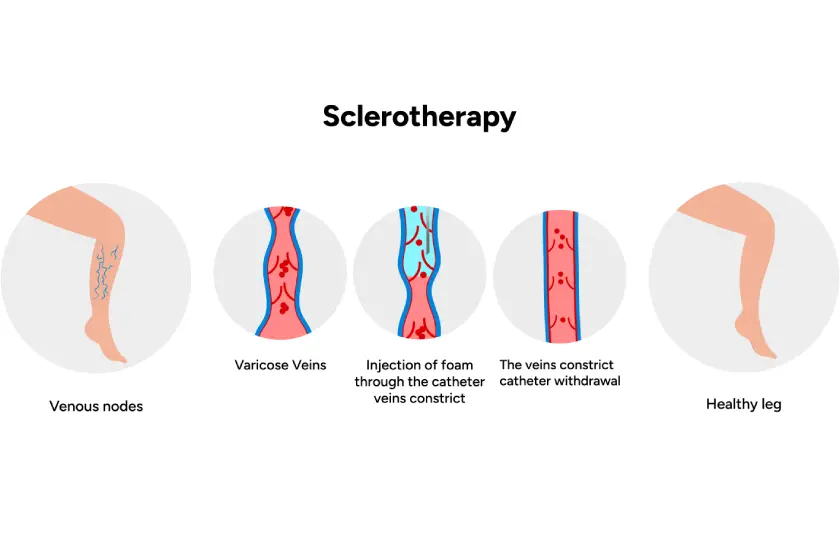
Sclerotherapy for spider veins is a minimally invasive treatment that involves injecting a special solution directly into the affected vein.
This solution irritates the inner lining of the vein, which causes the vein walls to collapse and seal shut. Once this happens, blood is naturally redirected to nearby healthy veins.
Over time, the body absorbs the closed vein, and it gradually fades from view.
Because the treatment is quick and effective, it has become one of the most commonly used methods for spider vein removal treatment. In many clinics, it is also performed as a sclerotherapy varicose veins treatment when small varicose veins are present.
Most sessions take less than thirty minutes, and patients are usually able to walk and return to normal activities shortly afterward.
Sclerotherapy Procedure: How the Treatment Works
The sclerotherapy procedure is typically performed in a clinic and does not require anesthesia.
First, the doctor examines the affected veins to determine which areas should be treated. A very fine needle is then used to inject the sclerosing solution into the vein.
Once injected, the solution causes the vein walls to stick together and close. Blood flow immediately begins to move through nearby healthy veins instead.
Patients are usually asked to wear compression stockings for a few days or weeks after the treatment. These stockings help improve circulation and support the healing process.
Over the next few weeks, the treated veins slowly fade. Depending on how many veins are present, more than one treatment session may sometimes be needed.
Laser Vein Treatment for Spider Veins: How It Works
Laser vein treatment offers a different way to treat spider veins without using injections.
Instead of a solution, the doctor uses focused laser energy to heat the affected vein. The heat damages the vein walls and causes the vein to collapse.
Once the vein is closed, the body gradually absorbs it, and the visible vein fades over time.
Laser treatment is often recommended for very small spider veins that lie close to the surface of the skin. It can also be helpful for treating veins on the face, where injections may be less comfortable.
The laser treatment for spider veins cost may vary depending on the number of sessions required and the type of laser technology used.
Types of Laser Treatments for Spider Veins
Several types of laser vein treatment are used today.
Surface Laser Therapy
This treatment is commonly used for very small spider veins located near the skin. The laser device is placed over the skin and sends light energy through the skin to target the vein.
Endovenous Laser Treatment
This technique is usually used for larger veins. A thin laser fiber is inserted into the vein, delivering energy from inside the vein to seal it shut.
Both techniques aim to eliminate the damaged vein so that the body can gradually absorb it.
Sclerotherapy vs Laser Treatment for Spider Veins: Key Differences
Although both treatments are effective, they work in slightly different ways.
The most obvious difference is the treatment method. Sclerotherapy for spider veins uses injections to collapse the vein from the inside, while laser vein treatment uses heat from light energy to seal the vein.
Another difference is the type of veins treated. Sclerotherapy is often preferred for spider veins on the legs and for small varicose veins. Laser therapy may be better suited for very small veins or veins located on the face.
Cost may also vary. The sclerotherapy treatment cost depends on the number of veins treated and the number of sessions required. Similarly, the laser treatment for spider veins cost may increase if several treatment sessions are needed.
Both treatments generally involve minimal downtime, and most patients can resume their usual activities shortly after the procedure.
Conclusion
Both sclerotherapy for spider veins and laser vein treatment are effective options for treating visible veins. Each treatment has its own advantages, and the most suitable option often depends on the size and location of the veins being treated.
In many cases, sclerotherapy varicose veins treatment continues to be one of the most trusted solutions for spider veins on the legs. Laser therapy may be recommended for smaller veins or veins in more delicate areas.
A proper evaluation by a vascular specialist is important to determine the most appropriate spider vein removal treatment and achieve the best possible results.
Frequently Asked Questions
Both sclerotherapy and laser vein treatment are considered safe when performed by trained vascular specialists. The safest option depends on the size and location of the veins.
Spider veins usually begin to fade within three to six weeks after the sclerotherapy procedure, although larger veins may take a few months to disappear completely.
Sclerotherapy permanently closes the treated vein. However, new spider veins may develop over time and may require additional treatment.
The sclerotherapy treatment cost in India generally ranges between ₹4,000 and ₹10,000 per session, depending on the clinic and the number of veins treated.
After the treatment, patients may notice mild redness, swelling, or bruising around the treated veins. Compression stockings are usually recommended, and most people can resume normal daily activities the same day.

Dr. Sumit Kapadia
MBBS, MS, MRCS, DNB-Fellow