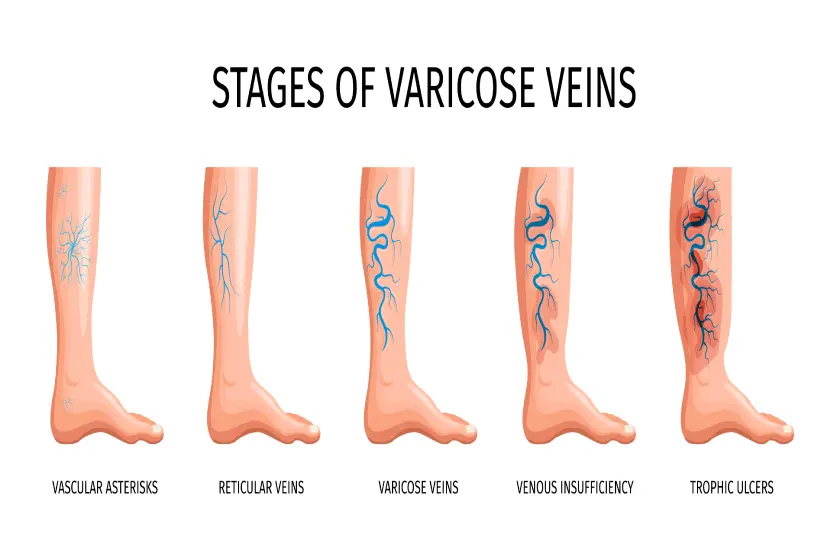
You are standing in front of the mirror, perhaps getting ready for work or a family function, when you notice it for the first time: a web of blue, zigzagging lines tracing down your calves. It is a moment that usually triggers an immediate, uncomfortable thought: Is this the beginning of the end for my legs?
As a vascular surgeon Vadodara families have trusted for years, I have seen that look of quiet panic in thousands of eyes. We often ignore our legs until they start telling us stories in shades of blue and purple.
But here is the reality: not every blue vein is a sign of a failing system. Some are just the natural result of a life well-lived, while others are a silent SOS from your circulation.
Before you start searching for laser treatment for varicose veins or worrying about the varicose veins laser treatment cost, you need to know exactly what those bluish veins on your legs are trying to tell you.
What Are Blue Veins in the Legs?
When we talk about visible blue veins on legs, we are usually looking at reticular veins or sometimes very superficial spider veins. These are essentially veins that are carrying deoxygenated blood back toward your heart.
Because the blood is low in oxygen and the vein walls are thin, they reflect light in a way that makes them appear blue, green, or purple through the skin. Unlike the deep veins buried inside your muscles, these are part of the superficial system.
By themselves, they are not a disease, but rather a window into how your vascular system is handling the daily pressure of gravity.
When Blue Veins in Legs Are Completely Normal
For many people, normal veins in the legs are simply more visible due to skin tone or lifestyle. If you have fair skin, a lower body fat percentage, or as you age and your skin becomes naturally thinner, those blue lines will become more prominent.
This is completely normal and often just a cosmetic trait. Similarly, after a heavy workout at the gym or a long walk along the Vishwamitri, you might see these veins pop out more.
As long as they are flat, painless, and don’t change in texture, there is usually no reason to lose sleep over them.
When Visible Blue Veins May Be a Cause for Concern
The transition from normal to concerning happens when those flat blue lines start to change their behavior. If you notice that the bluish veins on your legs are becoming raised, rope-like, or twisted, the internal valves might be failing. When these valves don’t close properly, blood pools downward, increasing the pressure and stretching the vein walls.
If the area around the vein feels warm to the touch, or if you notice the skin turning a brownish, rusty color, it’s a signal that the plumbing in your legs is under significant stress.
Blue Veins vs Varicose Veins: What’s the Difference?
It is important to distinguish between the two. Think of blue veins as the early warning or the small ripples on the surface. They are typically flat, less than 3mm in diameter, and rarely cause physical pain.
Varicose veins, on the other hand, are the waves. They are larger, bulging, and often gnarled like a tree root.
While blue veins are often just a cosmetic annoyance, varicose veins are a clinical condition indicating that the venous pump is struggling to fight gravity, which can eventually lead to complications like skin ulcers or blood clots.
Symptoms That Suggest Vein Disease
If your blue veins are accompanied by any of these Heavy Leg symptoms, it is time to look deeper:
- A persistent aching or throbbing sensation that feels worse after standing at work all day.
- Swelling in the ankles or calves that magically disappears when you wake up in the morning but returns by evening.
- Muscle cramping or a restless feeling in the legs at night.
- Itching or a burning sensation directly over the visible veins.
How Vein Problems Are Diagnosed
In my Vadodara clinic, we don’t guess: we visualize. The gold standard for diagnosis is a non-invasive Color Doppler Ultrasound.
This test allows us to see the blood moving in real-time. It tells me exactly which valves are leaking and if the blue veins you see on the surface are being fed by a deeper, leaky vein that we cannot see with the naked eye. It is quick, painless, and provides the blueprint for your treatment.
Treatment Options for Problematic Veins
The good news is that modern vascular medicine has moved far beyond the painful vein stripping surgeries of the past.
When No Treatment Is Needed
If your veins are asymptomatic and the ultrasound shows healthy valve function, we often recommend simple lifestyle shifts. Elevating your legs, staying hydrated, and using medical-grade compression stockings can prevent these veins from ever becoming a medical problem.
Laser Treatment for Varicose Veins
For veins that have become diseased, laser treatment for varicose veins (also known as EVLT) is the modern miracle. We use a tiny laser fiber to deliver heat directly inside the damaged vein, causing it to seal shut.
The body then naturally reroutes the blood to healthier, deeper veins. There are no large incisions, no stitches, and most of my patients are back to their routine walks the very next day.
Varicose Veins Laser Treatment Cost: What Affects It?
A common question I get is about the varicose veins laser treatment cost. In India, this typically ranges between ₹50,000 to ₹1,50,000 per leg, but the final figure depends on several factors. The extent of the disease (is it one leg or both?), the type of laser fiber used, and the hospital facility chosen all play a role.
While it might seem like an investment, it is a one-time procedure that prevents the much higher costs of treating future complications like non-healing leg ulcers or deep vein thrombosis.
When Should You See a Vascular Surgeon?
If you are in Gujarat and searching for a vascular surgeon Vadodara, the best time to visit is before the pain starts.
You should book a consultation if your veins are bulging, if you have one-sided leg swelling, or if you simply want the peace of mind that your blue veins aren’t a hidden vascular threat. Addressing vein health early is the best way to keep your legs feeling light and your circulation moving perfectly.
Conclusion
Blue veins are often just a part of the map of our lives, but they shouldn’t be ignored if they start to shout. By staying active and getting a professional check-up when symptoms arise, you can ensure your legs stay healthy for years to come. Don’t wait for the bulge: listen to what your veins are telling you today.
Frequently Asked Questions
You should worry if the veins are bulging, painful, accompanied by leg swelling, or if the skin around them is changing color or becoming itchy.
For cosmetic blue veins, sclerotherapy (injections) or simple skin lasers work well. For larger, diseased veins, endovenous laser treatment is the most effective fix.
Unhealthy veins are usually dark purple or deep blue and appear twisted or raised above the skin surface.
Not necessarily. Most blue veins are just superficial. However, if a vein suddenly becomes hard, red, and very painful, it could indicate a superficial clot and needs immediate medical attention.
Dehydration makes your blood volume drop, which can actually make veins look sunken or less visible. If they are popping out, it’s usually related to pressure or skin thickness rather than water intake.

Dr. Sumit Kapadia
MBBS, MS, MRCS, DNB-Fellow