

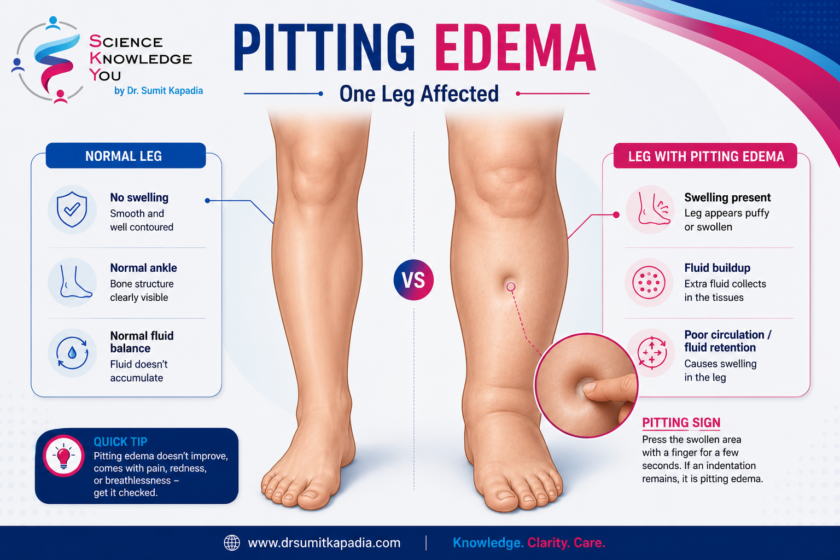
Pitting edema is swelling that leaves an indentation in your skin when you press on the area and then remove your finger. This itself is not a disease but a clinical sign that could be related to an underlying disease of the heart, kidneys, liver, veins, or lymphatic system.
When the cause is determined, the swelling can usually be treated successfully. This article describes what pitting edema is, its causes, symptoms, diagnosis, treatment options, grading of severity, and when to see a medical care provider.
Key Takeaways
- Pitting edema is swelling that briefly holds an indentation when pressed. It is a sign, not a disease.
- Common causes of pitting edema are heart, kidney, and liver disease, venous insufficiency, pregnancy, and certain medications.
- Severity and progress are described with a grading scale from 1+ to 4+ used by clinicians.
- Treatments of pitting edema depend on the underlying cause
What Is Pitting Edema?
Pitting Edema Meaning Explained
Pitting edema is soft and compressible, not a hard swelling associated with injury. If you push on the swollen skin, it will leave an indentation and slowly go back to normal. This is due to excess fluid collecting in the tissues just under the skin.It most often affects the feet, ankles, and lower legs where fluid collects, thanks to gravity.
What Causes Pitting Edema?
Pitting edema causes vary widely, so treatment is guided by the underlying diagnosis rather than the swelling.
- Fluid Retention: Holding on to sodium and water can produce mild, often temporary swelling.
- Chronic Venous Insufficiency: When leg-vein valves weaken, blood pools in the lower limbs and pushes fluid into the tissue.
- Heart Failure: A weakened heart pumps less efficiently, so fluid backs up in the legs and ankles.
- Kidney Disease: Damaged kidneys struggle to clear surplus fluid and sodium, which then settle in the tissues.
- Liver Disease: Cirrhosis lowers protein production and raises pressure in abdominal veins, encouraging fluid to escape.
- Pregnancy: Increased blood volume and pressure on pelvic veins commonly cause mild foot and ankle swelling.
- Certain Medications: Some blood pressure drugs, anti-inflammatories, steroids, and hormones promote fluid retention as a side effect.
- Prolonged Standing or Sitting: Staying in one position lets gravity draw fluid downward into the lower legs.
- Malnutrition: Low protein levels reduce the blood’s ability to hold fluid in the vessels, letting it leak out.
- Lymphedema: A blocked lymphatic system traps protein-rich fluid. In advanced stages, the swelling can become firm and non-pitting.
Pitting Edema Symptoms and Signs
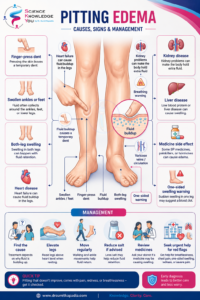
Symptoms of pitting edema vary depending on the underlying medical condition, but several signs are common.
- Swollen ankles, feet, or legs are usually the first noticeable symptom.
- Pressing the swollen area leaves a temporary indentation (pit) that slowly returns to normal.
- The skin may appear tight, stretched, or shiny as fluid accumulates.
- The affected limb may feel heavy and become less flexible, making movement uncomfortable.
- Pain or discomfort may occur in some people, while others experience little or no pain despite the swelling.
Understanding the Pitting Edema Grading Scale
Pitting Edema Grading (1+ to 4+)
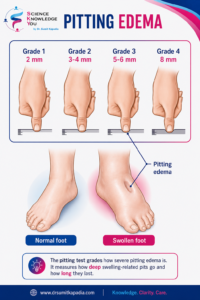
To describe severity, clinicians rely on a standard pitting edema grading scale running from 1+ to 4+. They press the skin and note two things: how deep the pit is and how long it takes to rebound.
Grading matters because it gives providers a consistent way to communicate severity and to monitor whether a condition is worsening or improving. It also helps judge how well treatment is working over time
| Grade | Pit Depth | Rebound Time | Severity |
|---|---|---|---|
| 1+ | Slight | Immediate | Mild |
| 2+ | Moderate | 10–15 seconds | Mild–Moderate |
| 3+ | Deep | More than 1 minute | Severe |
| 4+ | Very deep | 2–5 minutes | Very severe |
Higher grades usually suggest more fluid and a more serious cause, though location and accompanying symptoms matter just as much as the number.
How Is Pitting Edema Diagnosed?
Diagnosis aims to identify the underlying cause, not just treat the swelling.
- Doctors review your medical history, including symptoms, medications, and existing health conditions.
- A physical examination checks the location, extent, and severity of the swelling.
- A pitting test involves pressing the swollen area to see if an indentation remains.
- Blood tests and urine tests help detect infections, kidney disease, or other medical conditions.
- Kidney and liver function tests assess whether these organs are causing fluid retention.
- An ultrasound may identify blood clots or vein problems.
- An echocardiogram may be performed if heart disease or heart failure is suspected.
Pitting Edema Treatment Options
Pitting edema treatment focuses on the underlying cause rather than the swelling itself. For many people, simple lifestyle measures can help reduce fluid buildup, including elevating the legs, staying physically active, reducing salt intake, and maintaining a healthy weight.
Compression stockings are also commonly prescribed as they increase circulation and help prevent fluid from pooling in the lower legs. If heart, kidney, liver, or vein disease underlies the problem, treatment is aimed at controlling the condition. Sometimes doctors will prescribe diuretics (water pills), but these should only be taken under medical supervision.
When Should You See a Doctor for Pitting Edema?
Mild swelling is often harmless. But if the swelling develops suddenly and is accompanied by chest pain or difficulty breathing, seek care immediately, as these may be signs of a blood clot or heart trouble. One-sided swelling, severe pain, fever, skin discoloration, or open sores over the swollen area should also not be ignored.
Can Pitting Edema Be Prevented?
You cannot prevent every case, but sensible habits lower the risk. Staying active, avoiding long stretches of sitting or standing, limiting sodium, and keeping to a healthy weight all support good circulation. Wearing compression stockings when advised and managing chronic illness add further protection.
Conclusion
Pitting edema is not a diagnosis on its own but a visible clue that the body’s fluid balance has been disturbed, sometimes by a serious condition. Because the swelling can stem from causes ranging from prolonged standing to heart, kidney, or liver disease, persistent or worsening swelling deserves timely evaluation rather than watchful waiting. The encouraging news is that, when the underlying cause is found early, appropriate pitting edema treatment can ease symptoms, protect the skin, and support a better quality of life.
Frequently Asked Questions
Pitting edema commonly results from systemic medical conditions like heart failure, kidney disease, liver cirrhosis, or chronic venous insufficiency. Other frequent causes include pregnancy, prolonged sitting or standing, high-salt intake, and certain medications, such as blood pressure drugs, nonsteroidal anti-inflammatory drugs (NSAIDs), and steroids.
The pitting edema grading scale evaluates swelling based on skin indentation depth and rebound time after pressure: Grade 1+ is mild (2 mm pit, rapid recovery), Grade 2+ is moderate (4 mm pit, 10-15 second recovery), Grade 3+ is deep (6 mm pit, >1 minute recovery), and Grade 4+ is severe (8 mm pit, 2-5 minute recovery).
Mild, temporary swelling caused by prolonged sitting, warm weather, or high sodium intake often resolves on its own with elevation and rest. However, persistent, unexplained, or worsening pitting edema indicates an underlying organ or vascular issue that requires formal medical evaluation to resolve effectively.
Treatment targets the underlying root cause. Options include dietary sodium restriction, leg elevation, and compression socks for venous issues. When underlying organ disease causes severe fluid retention, doctors often prescribe diuretics to eliminate excess fluid. Always follow professional medical guidance before starting any targeted therapy.
It can be serious when tied to organ dysfunction like heart, liver, or kidney failure. Seek immediate emergency care if swelling onset is sudden, affects only one leg, or is accompanied by chest pain, severe shortness of breath, coughing blood, or dizziness.
Dehydration itself is not a direct cause of pitting edema. However, severe fluid loss can trigger secondary hormonal shifts that cause the body to retain water once fluids are ingested, potentially aggravating fluid imbalance in individuals with existing cardiovascular or renal conditions

Dr. Sumit Kapadia
MBBS, MS, MRCS, DNB-Fellow